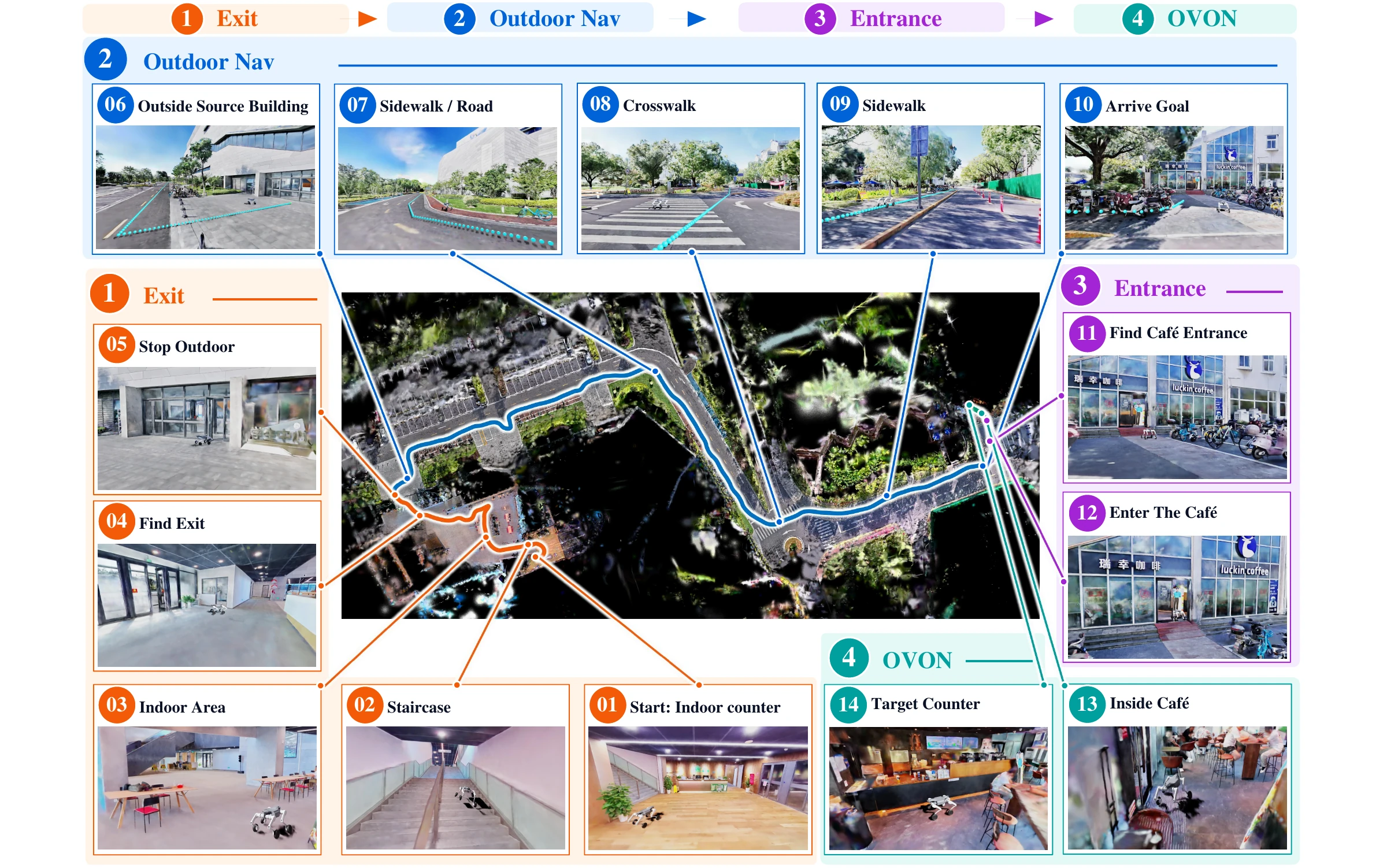
Four stages, two indoor–outdoor transitions, one continuous mission. Click any figure to view it at full size.
Overview
A robot's journey does not end at the doorway.
Service and delivery robots need to leave buildings, traverse outdoor spaces, enter a destination building, and find an object inside. I2O2I-Nav evaluates how these capabilities compose into a single, continuous mission.
The benchmark pairs reconstructed real-world environments with aligned 3D Gaussian Splatting (3DGS) rendering and collision geometry. Its three-level evaluation progresses from independent navigation primitives to two-stage compositions and full indoor-to-outdoor-to-indoor missions. Each stage continues from its predecessor's actual endpoint.
20real-world composite scenes
115,602.9 m²total annotated area
1,374evaluation episodes
3levels of composition
A journey from one building to another, through stairs, outdoor routes, and a destination entrance. This trajectory-following demonstration illustrates the environment and task stages; it is not a MODULAR-Agent evaluation rollout. Playback-speed labels are retained from the source video.
From Real-World Scenes to Executable Missions
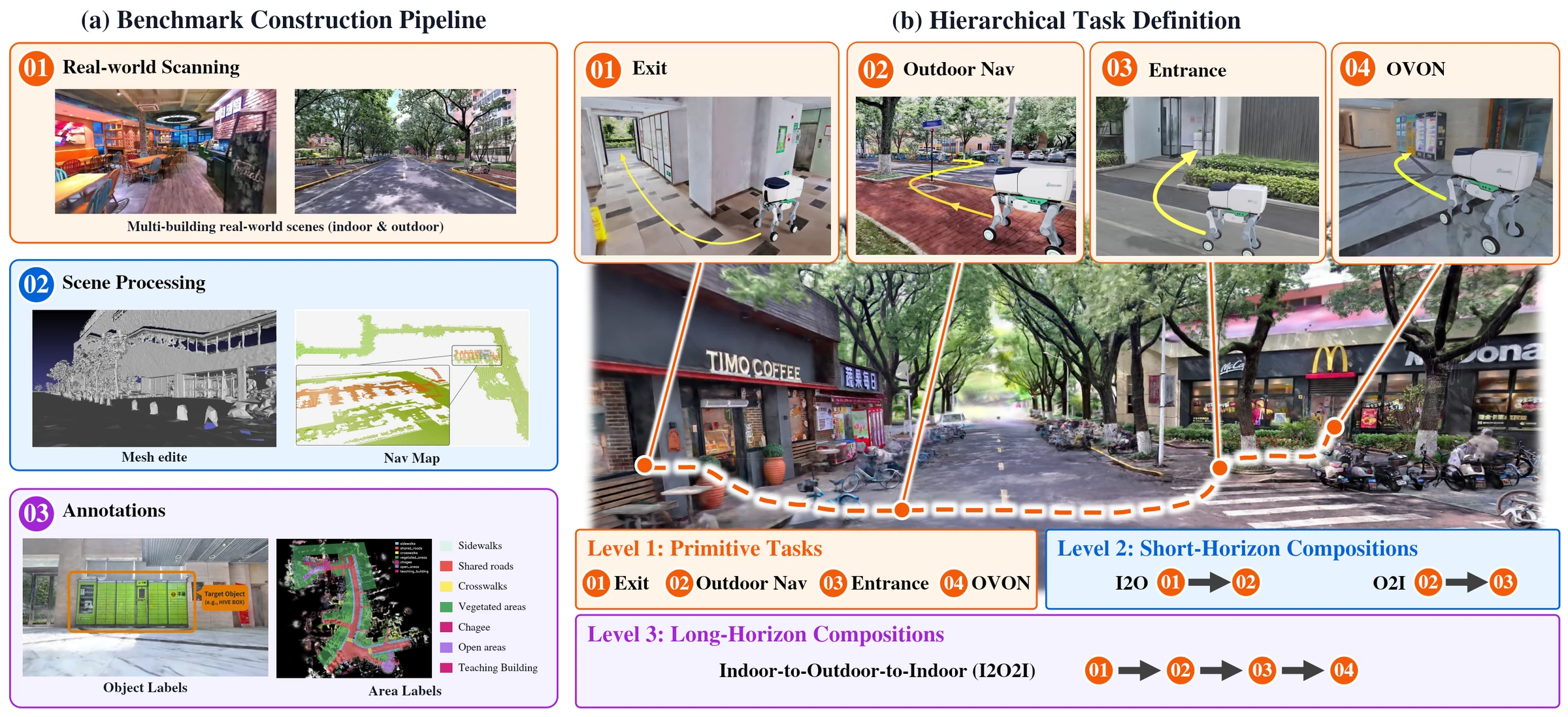
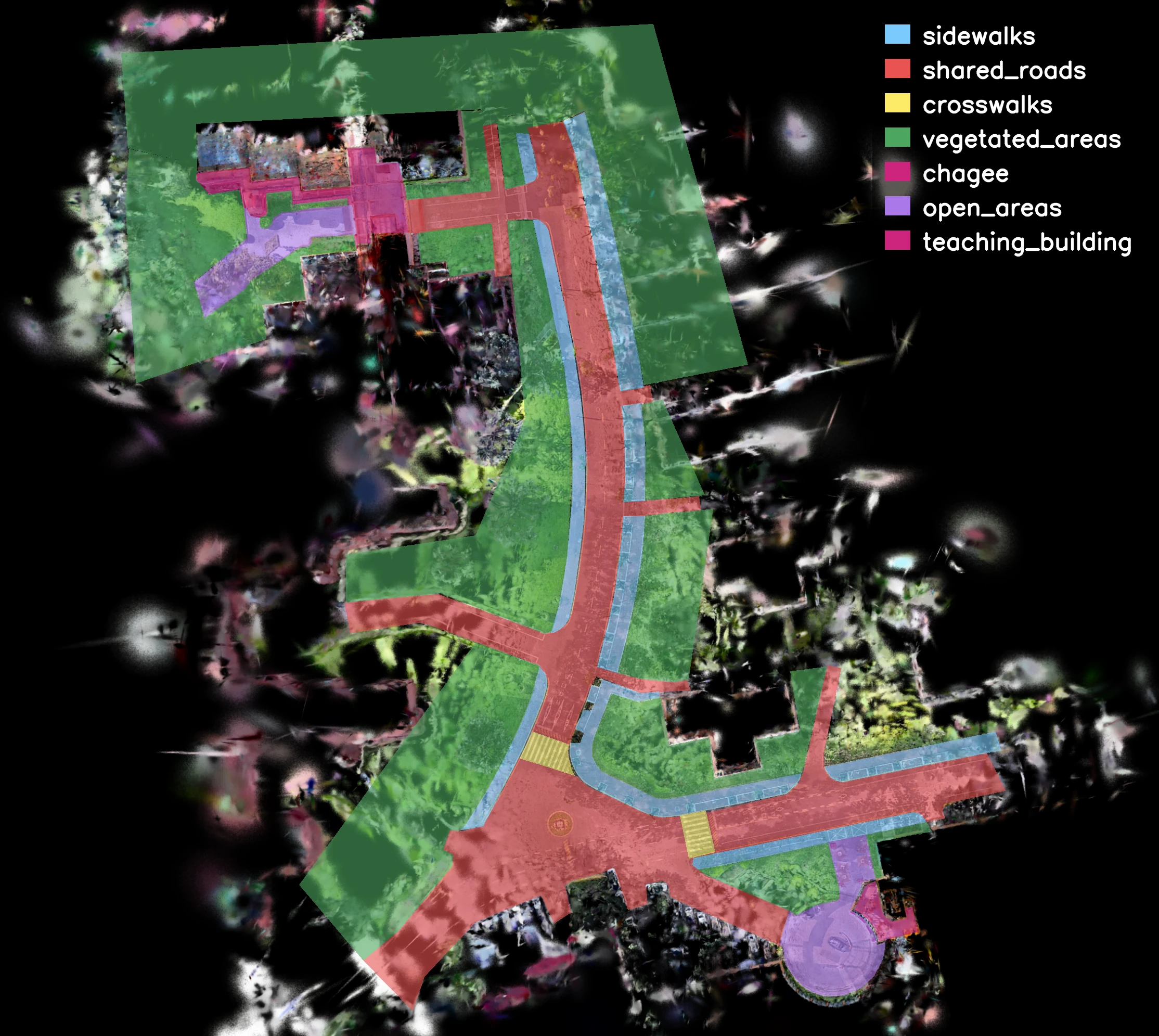
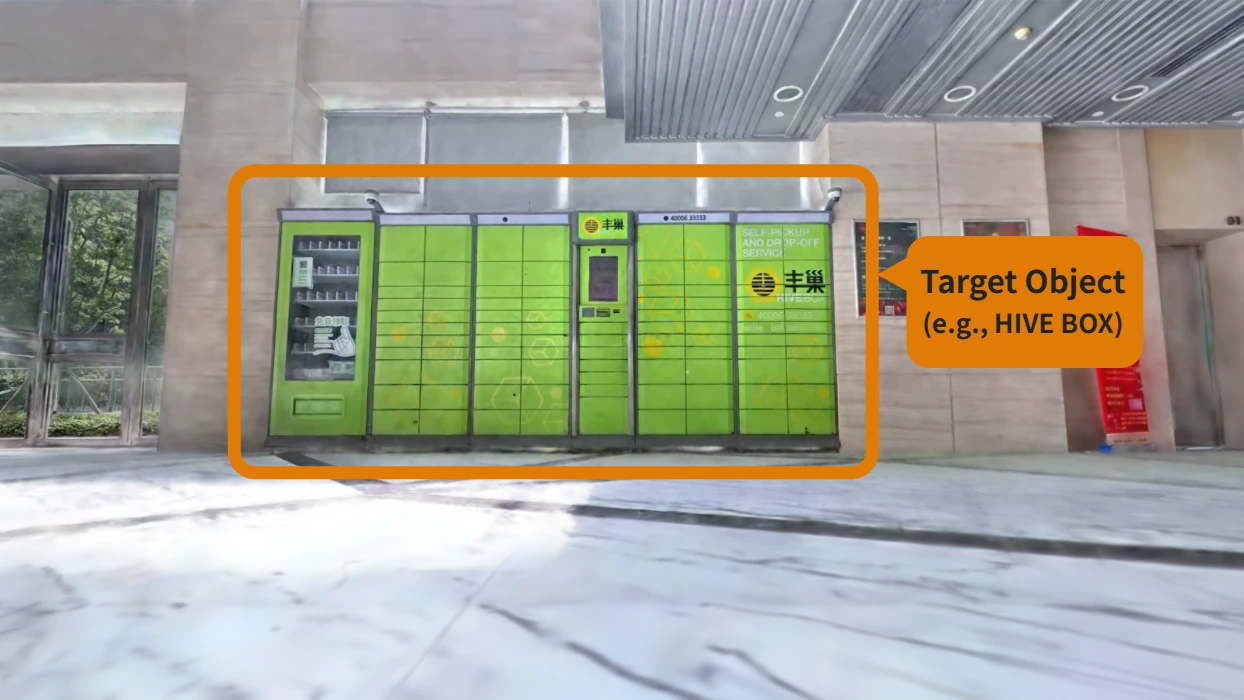
Real-world scans are processed into environments with visual reconstruction, collision geometry, navigation maps, and object- and area-level annotations. Building and floor labels define goals and boundary checks; evaluator annotations are withheld from navigation methods.
Benchmark construction and hierarchical task definition, reproduced from the paper.
Connected Indoor–Outdoor Environments
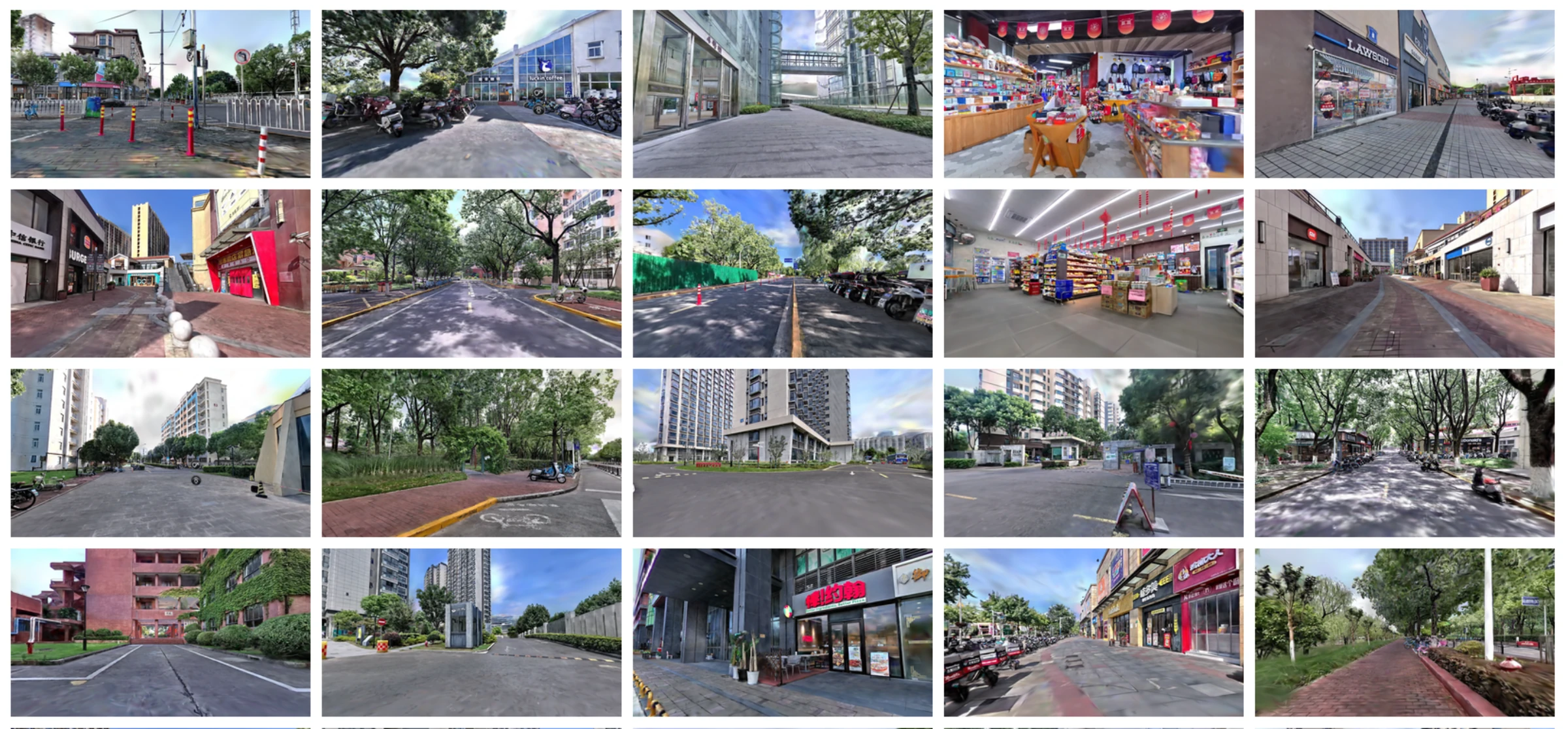
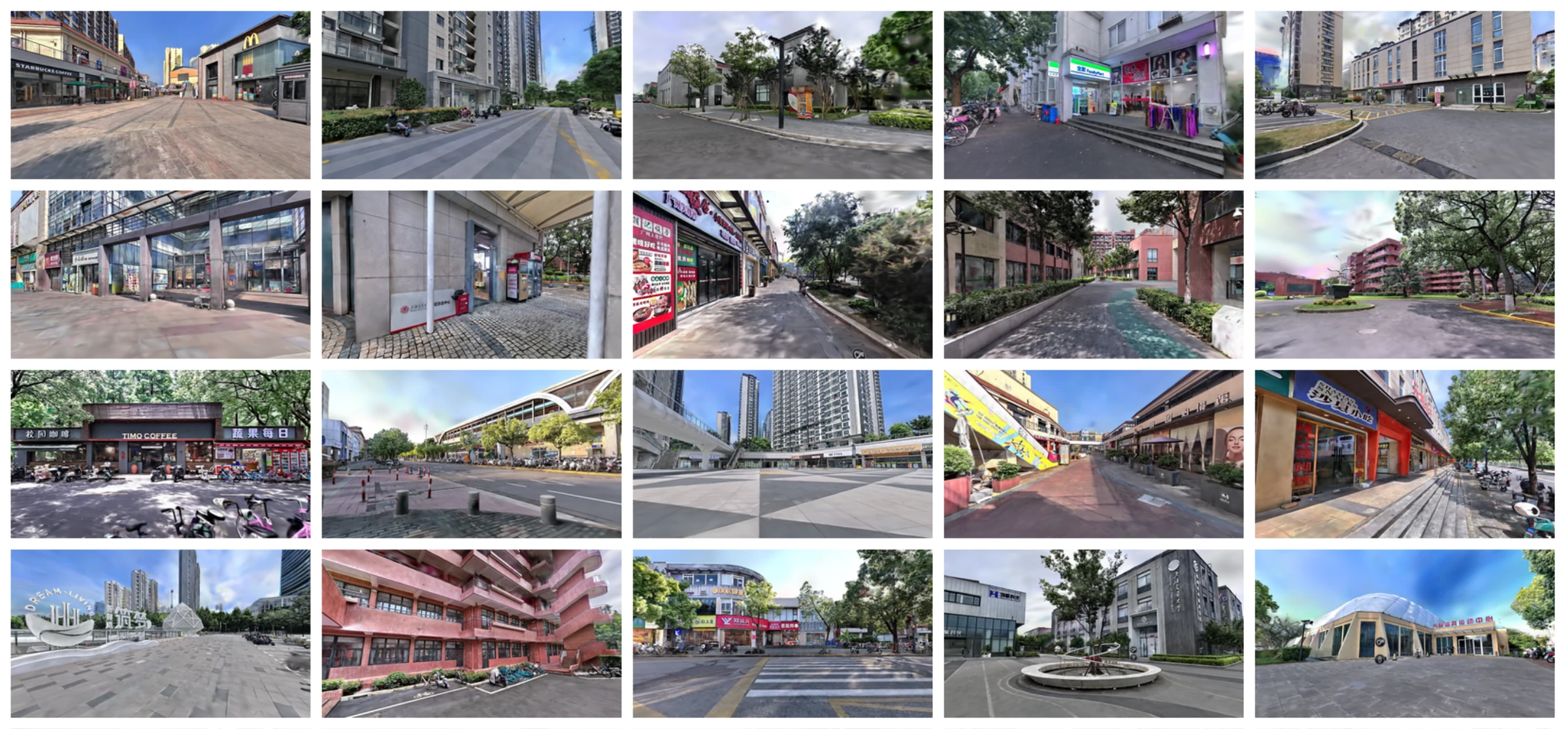
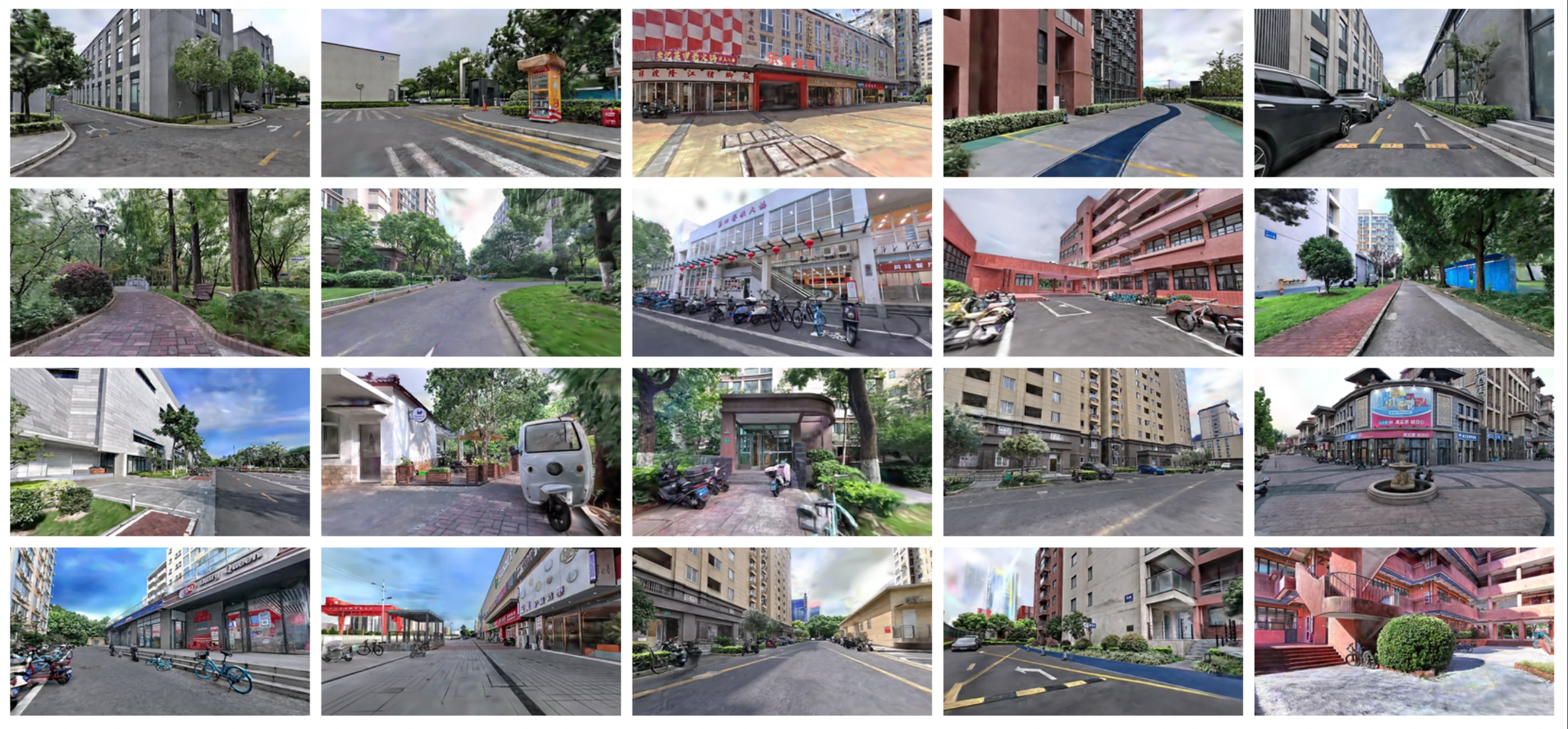
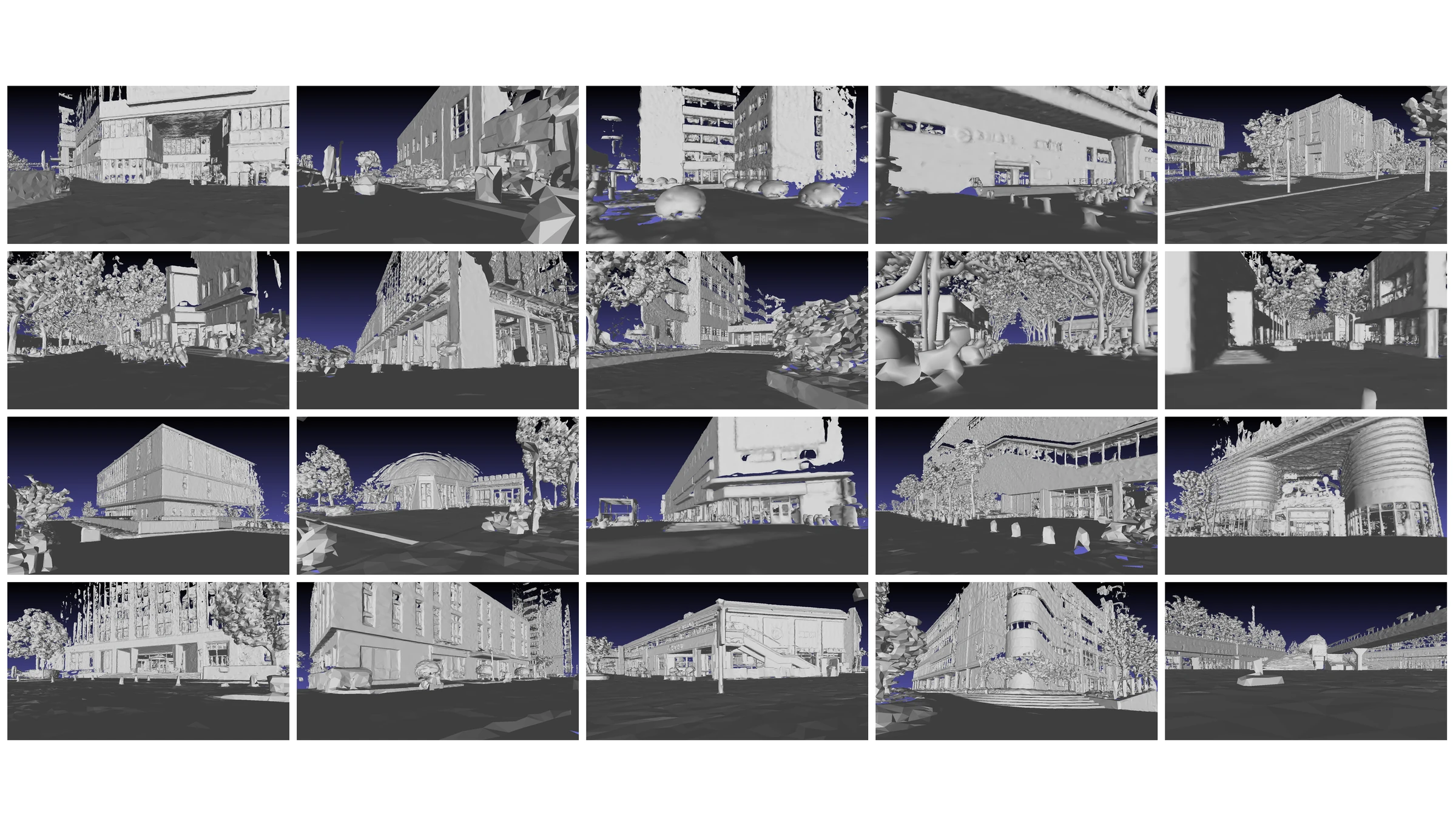
The 20 composite scenes span schools, offices, residences, shopping areas, and parks, connecting multiple buildings and floors. Explore sampled views and reconstructed mesh geometry below.
Scene views 01 · Sampled environment views.
Scene views 02 · Sampled environment views.
Scene views 03 · Sampled environment views.
Reconstructed mesh geometry. Panels are not claimed to correspond one-to-one with the scene-view grids.
Area and region annotationsObject-goal annotations
Three Levels of Compositional Difficulty
Moving between stages means switching the active task while retaining the robot's actual position and orientation. Composed episodes run without simulator resets.
L1
One stage at a time
Independent primitives
200 episodes per primitive
01
Exit
Find an exit, physically cross the boundary, and stop in a valid outdoor region.
02
OutdoorNav
Reach an outdoor goal while following a reference route and respecting pedestrian-permitted regions.
03
Entrance
Locate an entrance, enter the target building, and stop at a valid indoor location.
04
OVON
Find a language-specified object and stop at a valid location near a matching instance.
↓Compose two stages
L2
Carry the state forward
Two-stage compositions
200 episodes per composition
I2O Indoor to outdoor
Exit→OutdoorNav
O2I Outdoor to indoor
OutdoorNav→Entrance
↓Connect the full mission
L3
One continuous journey
The complete I2O2I mission
174 episodes full missions
01ExitLeave the building
→
02OutdoorNavTraverse outdoor space
→
03EntranceEnter the destination
→
04OVONFind the target object
All four stages must succeed.Two indoor–outdoor transitions · Three stage handoffs · No resets
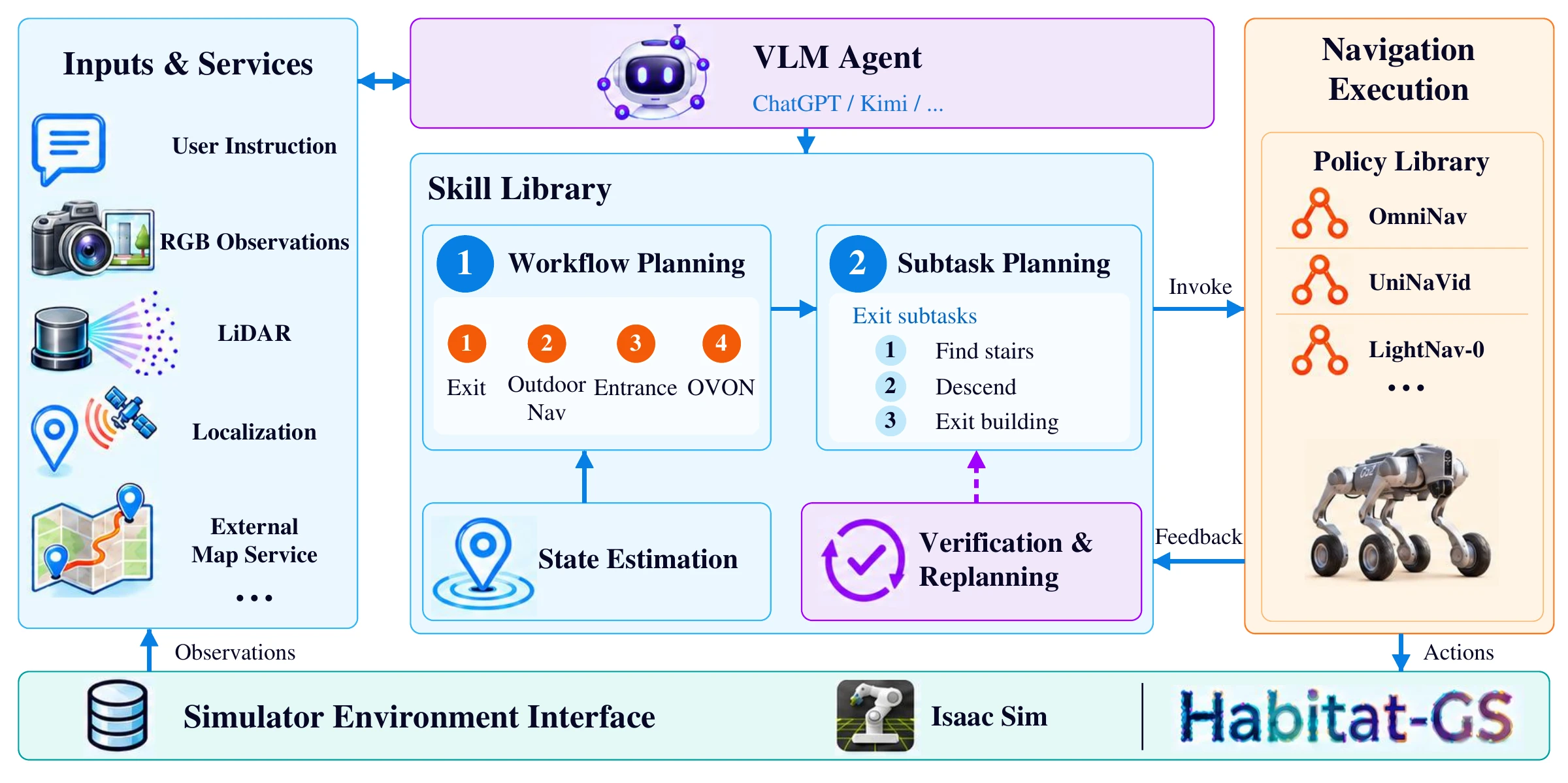
MODULAR-Agent
Plan. Execute. Verify. Recover.
A vision-language model coordinates frozen navigation policies through a reusable skills library. State estimation informs workflow and subtask planning; execution feedback drives completion verification, stage handoffs, and bounded recovery.
The architecture shows the supported module scope. In L2/L3 evaluation, OmniNav executes Exit, Entrance, and OVON; SocialNav executes OutdoorNav. Evaluated inputs and backends are specified in the paper.
Evaluation: Composition Remains Challenging
Using the same underlying policies, MODULAR-Agent raises I2O full success from 14.00% to 30.50% and O2I from 12.50% to 32.50%. Full four-stage success improves from 1.15% to 4.02%, while remaining low.
Evaluation uses a collision-constrained kinematic agent in Isaac Sim. All methods share task episodes, observations, action interfaces, success criteria, and execution budgets.
Level 1 · Independent primitives
L1 · Exit, Entrance, and OVON
Method
Exit
Entrance
OVON
SR ↑
SPL ↑
TL (m)
SR ↑
SPL ↑
TL (m)
SR ↑
SPL ↑
TL (m)
Uni-NaVid
0.00
0.00
1.14
0.00
0.00
1.49
7.00
7.00
0.59
OmniNav
29.00
18.29
156.11
14.50
10.26
35.53
38.00
35.73
21.19
LightNav-0
20.50
12.56
11.22
12.50
10.91
15.43
18.50
15.60
15.08
MODULAR-Agent (O)
45.50
29.56
74.54
51.00
30.78
48.02
40.50
32.26
46.28
L1 · OutdoorNav
Method
SR ↑
SPL ↑
DCR ↑
OmniNav-fast
70.00
66.15
54.50
SocialNav
74.00
70.23
79.39
MODULAR-Agent (O)
74.00
69.32
55.35
MODULAR-Agent (S)
76.00
70.60
80.06
200 episodes per primitive. SR, SPL, and DCR are percentages; TL is in meters. Bold values reproduce the paper’s best-result formatting.
Level 2 · Two-stage compositions
I2O · Exit → OutdoorNav
Method
FSR ↑
CSR ↑
SPL ↑
RC ↑
DCR ↑
C₁ ↑
C₂ ↑
OmniNav + SocialNav
14.00
17.25
11.90
28.50
42.24
20.50
68.29
MODULAR-Agent (O + S)
30.50
36.50
23.41
51.32
57.96
42.50
71.76
O2I · OutdoorNav → Entrance
Method
FSR ↑
CSR ↑
SPL ↑
RC ↑
DCR ↑
C₁ ↑
C₂ ↑
OmniNav + SocialNav
12.50
42.75
8.78
82.93
53.39
73.00
17.12
MODULAR-Agent (O + S)
32.50
52.00
22.27
82.43
51.92
71.50
45.45
200 episodes per composition. All values are percentages. C₁ and C₂ are stage-conditional success rates in task order.
Level 3 · Full mission
L3 · Exit → OutdoorNav → Entrance → OVON
Method
Full mission
Stage-conditional success
FSR ↑
CSR ↑
SPL ↑
RC ↑
DCR ↑
C₁ ↑
C₂ ↑
C₃ ↑
C₄ ↑
OmniNav + SocialNav
1.15
14.22
0.90
35.62
43.81
29.89
67.31
28.57
20.00
MODULAR-Agent (O + S)
4.02
26.15
1.08
47.79
56.05
45.40
79.75
52.38
21.21
174 episodes. All values are percentages. C₁–C₄ follow Exit, OutdoorNav, Entrance, and OVON. Full success requires all four stages.
Metric definitions and policy assignments
SR: success rate. FSR: full success rate. CSR: mean fraction of stages completed as a valid ordered prefix. SPL: success-weighted path efficiency. TL: mean traveled distance in meters. RC: reference-route progress from the final position's planar projection. DCR: outdoor distance compliance rate. Ck: stage completion conditional on successful completion of all preceding stages.
L1 (O)/(S) denotes OmniNav/SocialNav executors; OutdoorNav (O) uses OmniNav-fast. L2/L3 (O + S) combines OmniNav for Exit, Entrance, and OVON with SocialNav for OutdoorNav. The fixed chain advances on executor completion proposals; MODULAR-Agent adds completion verification and bounded recovery. All table values except TL are percentages. Higher is better for these percentage metrics; TL is descriptive.
Where Do Missions Break Down?
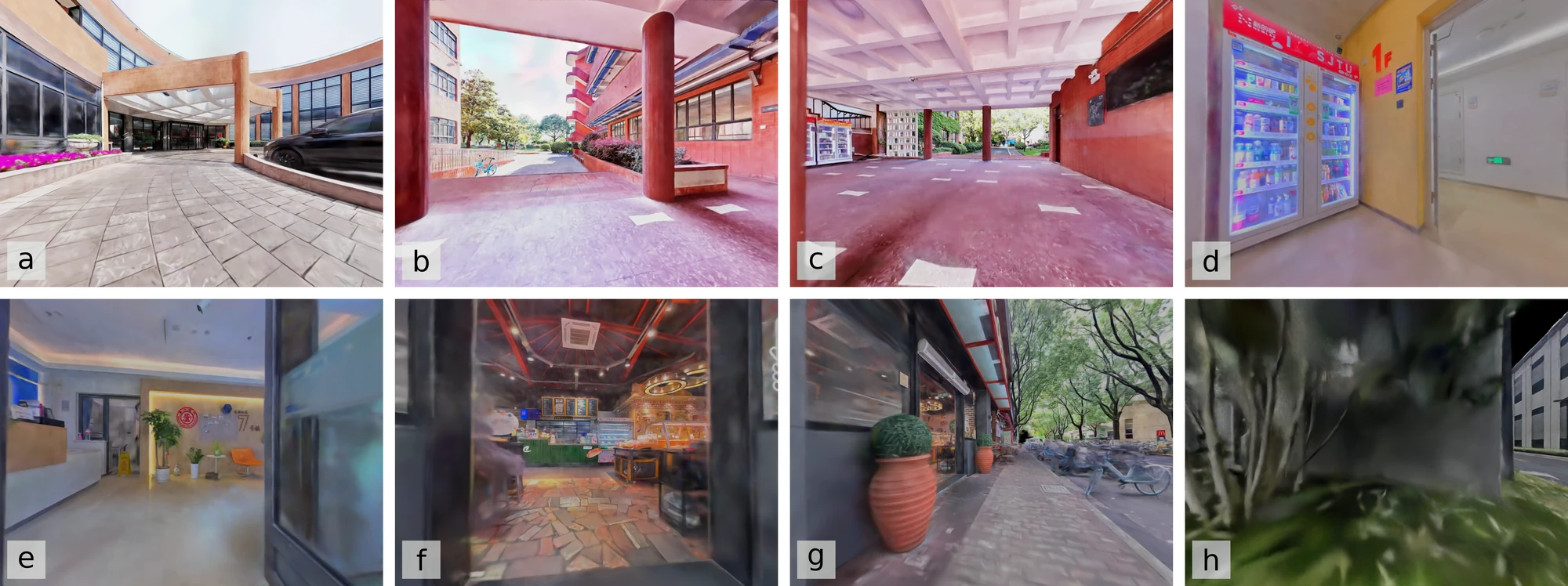
Seeing outdoor space does not guarantee a valid exit; approaching a doorway does not guarantee entry. Visible objects can be missed, and repeated actions can leave a robot stuck. These cases motivate explicit completion verification and recovery.
Representative L1 failures from the paper: Exit (a,b), OVON (c,d), Entrance (e–g), and OutdoorNav (h).
Stage-conditional evaluation reveals both early attrition and final-goal failures. For MODULAR-Agent, conditional success at the final OVON stage is 21.21%, leaving efficient and reliable object search a substantial challenge.
Citation
BibTeX
@misc{shu2026i2o2inav,
  title = {I2O2I-Nav: A Benchmark with a Modular Agent for
           Long-Horizon Indoor-to-Outdoor-to-Indoor Navigation},
  author = {Zhengjie Shu and Wanyu Li and Di Xiao and Lingxin Jiang
            and Lai Jiang and Kaidi Hu and Xincheng Tang
            and Wenkang Hu and Haoran Wang and Jinchuan Zhang
            and Chang Chen and Wei Li and Jia Pan and Ruigang Yang},
  year = {2026},
  note = {Preprint},
  url = {https://i2o2i-nav.github.io/}
}